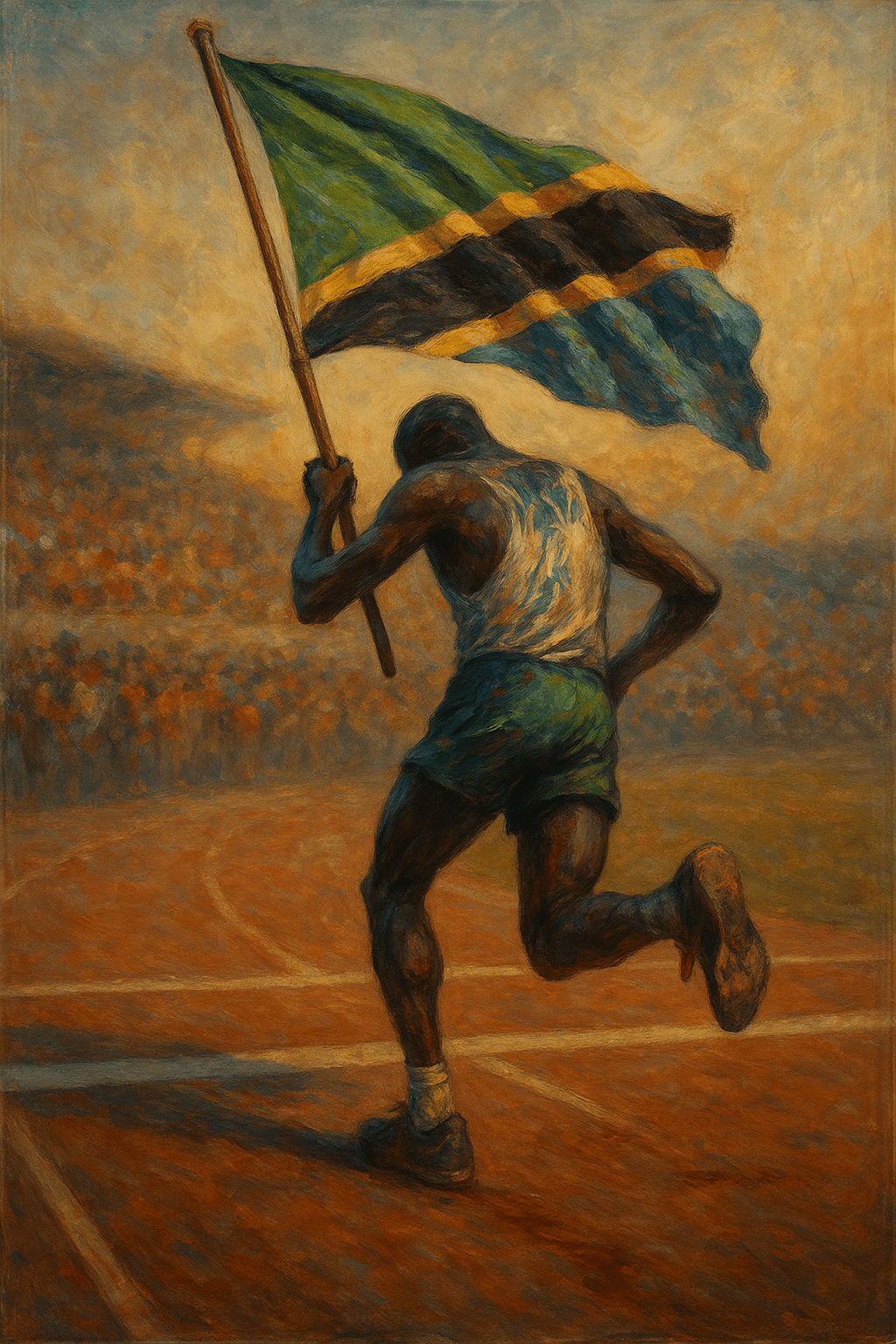
Most may have forgotten his name, but the Olympics have not.
In 1968, a Tanzanian athlete named John Stephen Akhwari did something unforgettable. In one of the most quietly patriotic acts ever witnessed on an Olympic stage, he finished a 42-kilometre marathon on a badly injured leg. Bloodied, limping, nearly collapsing, he crossed the finish line long after the race had ended. When asked why he didn’t just quit, his answer became a message for generations:
“My country did not send me 5,000 miles to start the race. They sent me 5,000 miles to finish it.”
To many, it was just a sentence. To us, it was a blueprint.
Akhwari didn’t win a medal. But he won something that medals can’t capture. He understood the assignment, not as an athlete alone, but as a flag bearer. He knew what it meant to be sent by a young nation, barely seven years after independence, only four years into a delicate union between Tanganyika and Zanzibar. He stood not just for competition, but for identity, for sacrifice, for continuity. Most of his victories were unseen, struggles that never made it to television, pains that the stadium crowd could not hear. Winning the marathon would have just been the icing on top of a long list of silent triumphs.
Being in the Olympics at all was a win. Carrying the flag to that track was a win. Running, even when the body said no, was a win. He finished not because he wanted applause, but because he knew he was there for something bigger than pain or position. And maybe, that’s what most of us forget.
We too are already winners. Just being here, alive in this complicated world, is proof that we overcame something. Maybe our wins are quiet: being born after ancestors who survived slavery, exile, disease, and betrayal. Maybe it’s the systems we now enjoy like education, healthcare, or even the right to speak, systems that were built on the backs of people we’ve never met. We inherit the baton of sacrifices we didn’t witness. That inheritance, whether we admit it or not, comes with an obligation.
The race is not about placement. It’s about purpose.
This life is not always kind. You may lose your balance. You may get injured. You may lag behind while others sprint ahead. But Akhwari’s story whispers something to the spirit: finish anyway.
He wasn’t trying to beat other runners. He was trying to honour those who sent him. His country. His family. His flag. His faith. His assignment.
And maybe you, too, have been sent. Maybe this life is your race. Maybe you were born not to impress, but to endure. Maybe you’re limping right now, quietly, while people cheer for others. Maybe you feel invisible. But the flag is still in your hand, and the finish line still matters.
Dr. Martin Luther King Jr. once said, “If you can’t fly, run. If you can’t run, walk. If you can’t walk, crawl. But by all means keep moving.” That is the fire Akhwari ran with.
And maybe, that’s what we need to remember: sometimes, the victory is simply not giving up. Carrying the flag to the finish even when no one is watching.
You were not sent to start. You were sent to finish.

 WAZA
WAZA 