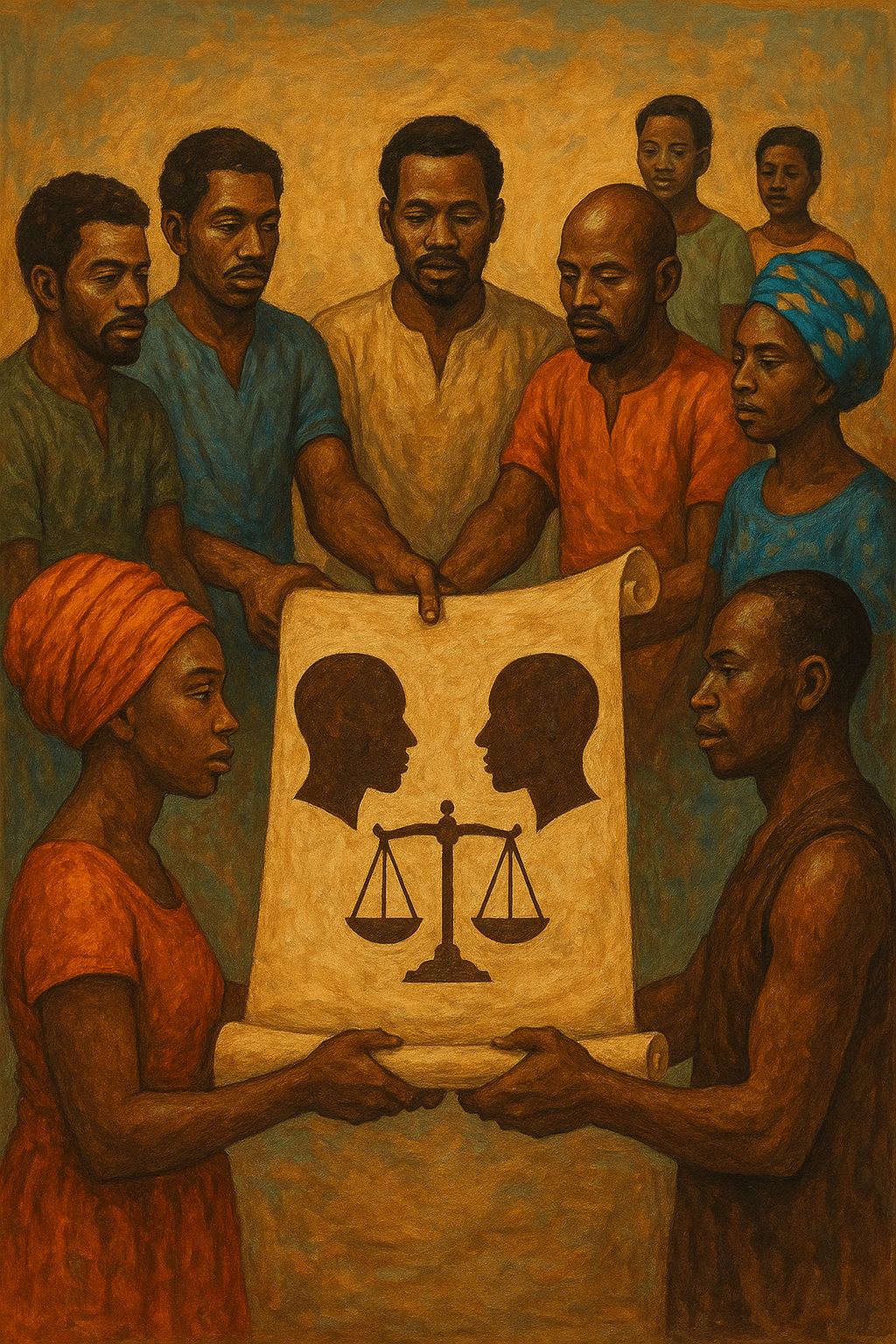
In law school, the debates over the social contract linger long after exams end. Names like Hobbes, Locke, Rousseau echo through lecture halls; their differences sharp, their arguments endless. Yet somewhere, in one point, they converge: society depends on agreements, often unwritten. Students argue, write, defend, attack. The debates feel exciting, controversial, sometimes even intimidating.
Then the exams end. Essays are submitted. Notes, past papers, scribbles stored away. Months or years later, when you open them again, maybe scanning what to keep and what to toss, the debates return. But this time, perhaps, you read them differently. No deadlines. No grades. No pressure to defend a position.
And suddenly, the social contract is no longer only a theory about governments or societies. Maybe it never was. Maybe it is here, in the quiet rhythm of daily life. Obligations you never formally accepted, yet cannot escape, appear in the people, the places, the things you touch every day. Everything you hold; knowledge, relationships, time, resources, has roots in moments and hands before you, and carries responsibilities deeper than you first imagined.
Maybe you begin to ask: How many things are entrusted to me? How often do I bend, misuse, or abandon them? And does it matter? When this reflection settles in, perhaps you see that the contract is not only out there, between state and citizen as portrayed in social contract classes. It is here, inside you. Unwritten, unsigned, yet undeniably real obligations exist; quiet agreements to care for what has been entrusted to you by society.
When you pause to consider the history that preceded you, the genes passed down through generations, the ways each era transforms the next, the glimpses of philosophy and religion that ponder purpose and existence, maybe you see a truth: countless agreements have been made, often unwritten, by those who came before. But so too were mistakes, injustices, and failures. Perhaps the contract is not just a ledger of promises to continue, but also a warning, a map of what must never be repeated. The obligation is not only to preserve their good work, but to learn from what did not work.
This is why societies invest in people. Education is provided, intelligence nurtured, medical facilities built, resources distributed, wealth generated; not for the momentary owner, not for show, not for personal gain. Maybe it is all meant to sustain life beyond ourselves, to honor the unbroken chain that brought these gifts to us.
And when this finally sinks in, perhaps the quietest realization comes: most of what you hold, most of what you shape, is never truly yours. Maybe it was never meant to be. You are part of a chain stretching backward through history and forward into the unknown. The children you guide, the knowledge you share, the land you tend, the care you offer; all of it has passed through hands before yours, and will continue through hands long after you are gone.
A parent waking early to prepare breakfast for a child is not just feeding them; maybe they are honoring a contract older than their own life. A teacher scribbling formulas on a blackboard is not merely teaching math; perhaps they are holding a thread of understanding across generations. A farmer tending soil is not just planting crops; maybe they are sustaining the promise of nourishment for strangers they may never meet. Even the quiet neighbor, checking in on the sick, is fulfilling a duty no law ever required, yet the world quietly depends on it.
And yet, most days, it is easy to forget. We cling. We hoard. We raise children as if they exist only to reflect our ego, rather than to carry the light forward. We guard knowledge, wealth, and influence as if the world would collapse without us. And in forgetting that we are trustees rather than owners, the fabric of life frays. Small cracks, where trust was abandoned, ripple far beyond our sight, touching lives we may never see or understand.
The challenge, then, is to hold without owning, to guide without controlling, to shape without claiming. Each act, each word, each choice resonates far beyond the moment. Maybe it is invisible, maybe it goes unnoticed, yet it sustains life nonetheless. It is the quiet labor of continuity; a duty that binds you to those who came before, and those who will come after.
True fulfillment may not come from what you conquer or acquire, but from what you preserve, protect, and pass on. Happiness may be found in the recognition that you are both a child of those who came before and a custodian for those who come after. Every sunrise you witness, every lesson you teach, every seed you plant, is part of an unspoken contract, a social contract written not in statutes or essays, but in the rhythm of life itself. To honor it is to participate in a story larger than yourself.
To neglect it is to fray a thread in a tapestry that stretches across generations. And in that quiet, almost imperceptible way, life reminds you: you are never merely here for yourself. You are here to keep the world moving, to tend what was given, and to leave it better than you found it. Maybe that is the essence of the social contract.

 WAZA
WAZA 